 Vancouver Island, Canada
Tongue and groove paneling and soffit
Clean, consistent tongue and groove for ceilings, soffits, cladding, feature walls and saunas, in engineered clear cedar or solid Douglas Fir.
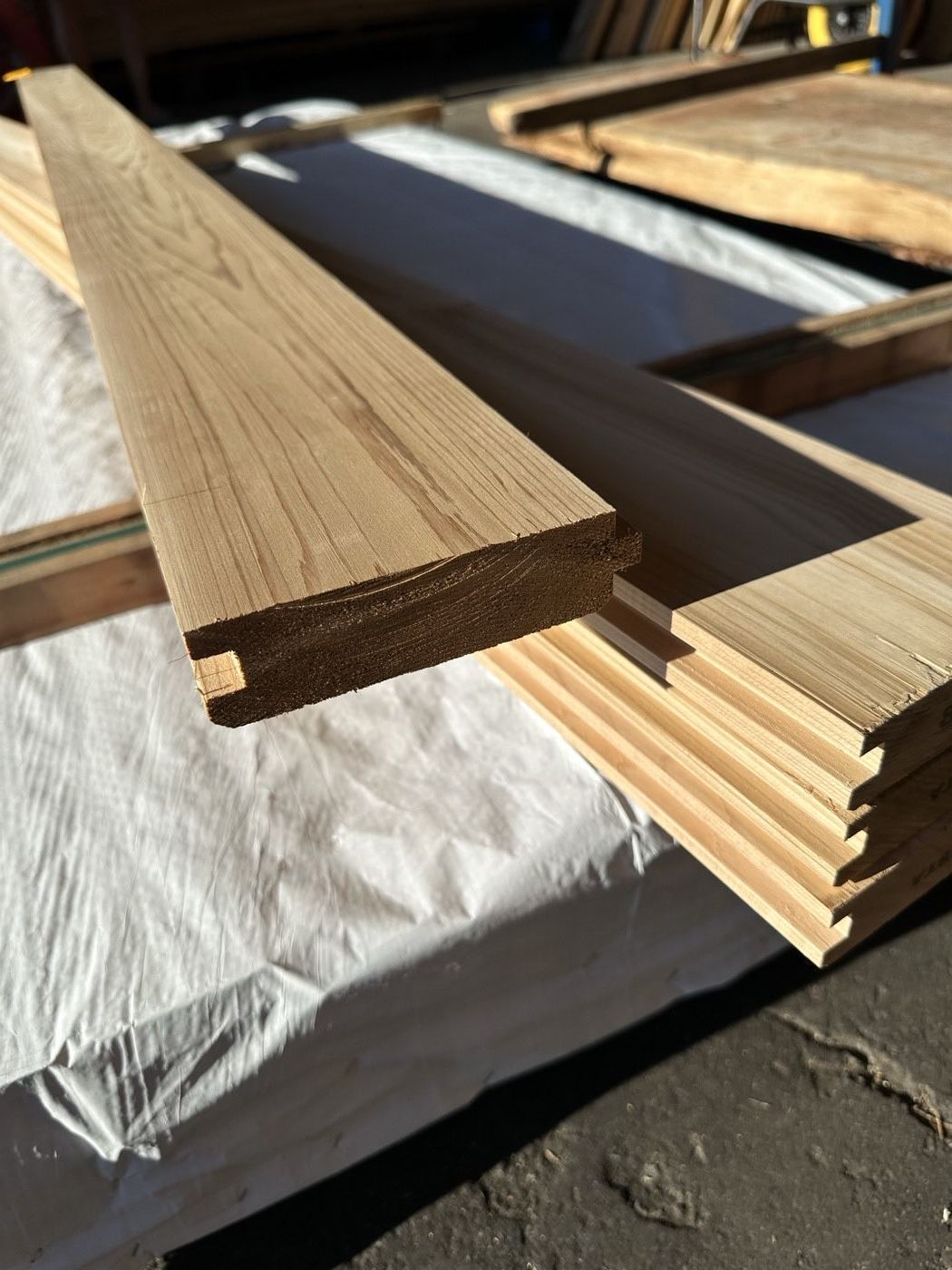
Our engineered tongue and groove is designed to make more from less. We take the best sections of lower-grade fibre and laminate them beneath a face of our highest-quality clear fibre, making a higher-grade product engineered for our coastal climate. It is stable, consistent and kept flat so the joint stays closed. Solid Douglas Fir tongue and groove is the solid-wood option.
- Clear vertical-grain Western Red Cedar face over a finger-jointed, kiln dried core
- Two face profiles: Fineline and Micro V
- Exterior grade adhesive; the joint is milled through the whole laminate
- Solid Douglas Fir tongue and groove also available
- Custom profiles made in house to match a sample or drawing
Specifications
- Species
- Western Red Cedar (engineered). Douglas Fir (solid).
- Grades
- Clear face over finger-jointed core. Douglas Fir: knotty.
- Profiles / patterns
- Fineline (fine-line flush face) and Micro V (micro V-joint). Douglas Fir: V-joint.
- Sizes
- 1x6 typical, with 1x4 and 1x8 also common. Finished thickness and face width on request.
- Finish options
- Smooth, or one face resawn. Natural, or primed and colour-ready on request. Finish with a breathable stain, or leave the cedar to weather.
- Lengths
- 1 to 2 ft shorts through 20 ft; specified or random lengths on request.
- Moisture
- Kiln dried before lamination.
- Lead time
- Stocked and available to order.
- Applications
- Exterior soffits and ceilings, cladding, interior ceilings and feature walls.
Why it stays flat
Each board is built in three layers: a clear cedar face, exterior grade adhesive, and a finger-jointed core. That construction is what keeps the joint closed.
- Finger-jointed core with alternating grain, so the board resists cupping
- Vertical-grain face for stable, even movement
- Kiln dried before lamination
- Clear face with no knots
- Less clear cedar used per board, from the best sections of lower-grade fibre
- Western Red Cedar's natural extractives resist decay
The engineered blank, with the profile milled in
Tongue on one edge, groove on the other, cut into the clear face over the finger-jointed core.
Profiles, explained
The drawings show the tongue and groove in three joint types: V-groove, 1/8 in. gap and flush, in end-grain section.
Sauna boards and shorts
Western Red Cedar sauna boards in STK grade, tongue and groove with a bullnose face, for sauna walls, bench cladding and ceilings. We also sell shorts, 1 to 2 ft Western Red Cedar and Douglas Fir offcuts, bundled for sauna kits, trim and craft work.